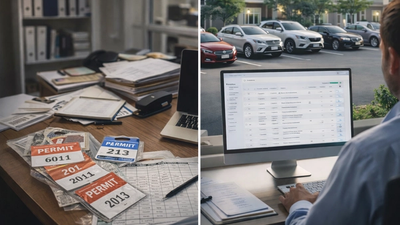

The best way to track resident vehicle registration without manual headaches or the cost of physical hangtags is to move your entire operation online. ApartmentPermits.com provides a seamless digital platform that eliminates physical hardware while automating your most time-consuming parking tasks
Parking administration rarely appears as its own line item on a property budget. It doesn't show up in your expense reports as "parking management"—instead, the costs scatter across office supplies, staff hours, resident disputes, and revenue you never collected. Most property managers assume parking permits are a minor operational detail, a box checked at move-in and forgotten.
But when you actually trace where the money goes—and where it doesn't come in—physical permit systems cost far more than the numbers suggest. The hangtag you order for $2 triggers a cascade of hidden expenses: the staff time to issue it, the replacement when it gets lost, the audit to verify it belongs to someone who still lives there, and the dispute when a vehicle gets towed without one. Worse, it creates friction that prevents you from capturing revenue that should be easy money.
This article is part of our Virtual Parking Permits: The Complete Guide for Multifamily Communities—but before exploring the solution, it's worth understanding exactly what the problem costs. Below, we break down every hidden expense in physical parking administration and provide a framework to calculate whether your current system makes financial sense.
The Direct Costs: What You're Paying For
Printing and Supplies
Physical permits require physical materials. Custom hangtags from professional printers typically run $0.42 to $3.10 per unit depending on order volume, with smaller properties paying closer to the higher end. A 200-unit property ordering permits at $2 each spends $400 just on initial materials—before accounting for replacements.
The replacement cycle compounds this expense. Permits fade in sun-exposed windshields. Residents lose them. Some properties require new permits at every lease renewal for security purposes, meaning annual reordering becomes standard practice. If even 20% of residents need replacements annually, a mid-sized property adds another $80-$160 per year in materials alone.
Temporary guest passes add further costs. Paper guest permits, parking stickers, and visitor hangtags all require ongoing inventory management and reordering cycles that rarely appear in budget planning.
Lost Revenue from Guest Parking
Here's a cost that never shows up on an expense report: the guest parking fees you're not collecting.
Many properties want to monetize guest parking—charging $5 or $10 per night seems reasonable. But with physical permits, collecting that money becomes an operational nightmare. Residents have to visit the office during business hours, pay with cash or check, and wait while staff processes the transaction manually. After hours? Forget it.
The friction kills the revenue stream before it starts. Most properties using physical systems either give up on charging for guest parking entirely or enforce it so inconsistently that collection rates stay painfully low.
Run the math: if a 200-unit property could realistically charge for 100 guest nights per month at $5 each, that's $6,000 per year in potential revenue. Even capturing half of that—$3,000—dwarfs the cost of the hangtags themselves. The "cheap" physical system isn't cheap when you account for the income it prevents you from collecting.
The Indirect Costs: What You're Not Tracking
Staff Time at the Desk
Every permit transaction takes time. Issuing a new permit at move-in requires explaining policies, collecting vehicle information, entering data into tracking systems, and physically handing over the credential. Replacements repeat this process. Guest passes often require office visits for each request.
What does this add up to? Estimate conservatively: 10 minutes per new permit, 5 minutes per replacement, 3 minutes per guest pass processed. For a property with 50 move-ins annually, 40 permit replacements, and 200 guest pass requests, that's roughly 18 hours of staff time per year dedicated solely to permit transactions.
At current leasing consultant wages of $20-$24 per hour in most metro markets, those 18 hours cost $360-$432 annually in labor—and that assumes no complications, no extended conversations, and no troubleshooting. The real number is almost certainly higher.
The opportunity cost matters more than the dollar figure. Every minute spent processing parking paperwork is a minute not spent on leasing tours, renewal conversations, or resident relationship building—activities that directly impact occupancy and revenue.
The Audit and Compliance Burden
Physical permits require manual verification. Someone needs to reconcile permit lists against current residents, identify credentials that should have been collected at move-out, and physically walk the lot to spot vehicles without valid permits.
Move-out permit collection presents a persistent challenge. Residents forget to return hangtags. Some leave them in vehicles they trade in. Others simply move out without completing the checkout process. Each uncollected permit represents either a security gap or future confusion when that permit reappears in your lot.
Lot audits—walking through and checking each vehicle against your records—consume hours of staff time with minimal payoff beyond identifying problems that shouldn't exist in the first place.
Dispute Resolution
When towing enters the picture, costs escalate rapidly. Residents whose vehicles are towed from their own property—often due to permit confusion, missing credentials, or expired temporary passes—rarely accept it quietly.
The time spent investigating complaints, reviewing records, and mediating disputes between residents, management, and towing companies adds up. A single contested tow can consume hours of staff attention and generate negative reviews that affect future leasing. One city ombudsman investigation found that towing disputes at apartment complexes caused significant financial and emotional impacts on residents, with initial tow costs starting around $268 and daily storage fees compounding quickly.
Without a digital audit trail, these disputes become "he said, she said" situations where no one can definitively prove what happened. Resolution often means absorbing costs simply to preserve resident relationships.
The Costs You Can't Quantify (But Feel Every Day)
Fraud and Abuse Leakage
Physical permits can be shared, counterfeited, or simply never returned. When a permit issued to apartment 204 appears in your lot months after that resident moved out, you've lost control of who's actually parking there.
Revenue leaks through unauthorized use. Former residents continue parking. Friends and family members borrow permits intended for vehicles they don't own. Guests overstay temporary passes. The result: paying residents compete for spaces with people who have no right to be there.
Properties charging for parking feel this most acutely. Every space occupied by someone not paying for it represents direct revenue loss—and frustration for residents who are paying.
The Price of a Bad Tow
Towing disputes don't just cost staff time—they can cost you residents.
Picture this: A resident's hangtag falls off the dashboard on a hot day. The adhesive fails, or it slips between the seats. Their car gets towed at 2 AM. They wake up to a $300+ bill, miss work retrieving their vehicle, and spend the next week furious at management.
That resident isn't renewing their lease.
The cost of one turnover—vacancy loss, unit turn expenses, marketing, and leasing labor—runs $3,000 to $4,000 for most properties. If a rigid physical permit system causes one wrongful tow that leads to a non-renewal, that single incident costs more than your entire annual permit budget. And unlike supply costs, turnover compounds: you're not just losing one month's rent, you're losing a resident who might have stayed for years.
Resident Frustration
From the resident perspective, physical permit systems create friction at multiple touchpoints. Office visits to replace lost permits. Wait times for guest passes. Confusion about where credentials need to be displayed. Anxiety about being towed for honest mistakes.
These frustrations show up in reviews. Properties with clunky parking systems see complaints about "parking hassles" and "difficult guest policies" that influence prospective renters researching communities online. The reputational cost doesn't appear on any budget sheet, but it affects occupancy.
A Simple Calculation Framework
Add up your parking administration costs using this formula:
(Permit materials × annual units needed) + (Staff hourly rate × hours per month on parking tasks × 12) + (Lost guest parking revenue) = Annual parking administration cost
Example: 200-Unit Property
Cost Category
Calculation
Annual Cost
Permit materials
240 permits/year × $2
$480
Staff time
2 hrs/month × $22/hr × 12 months
$528
Lost guest revenue
50 paid nights/month × $5 × 12 (at 50% capture rate)
$3,000
Total
$4,008
That estimate excludes towing disputes, audit time, move-out collection efforts, and turnover risk. Add one "rage move-out" from a bad tow, and you're looking at $7,000-$8,000 in real costs from a system that's supposed to be "basically free."
If your calculation surprises you, the system isn't working efficiently. The alternative isn't finding better hangtags—it's eliminating the cost category entirely.
From Cost Center to Non-Issue
Virtual permit systems remove every expense category discussed in this article. No printing costs. No manual audits or move-out collection. No "he said, she said" towing disputes—because digital records show exactly who was permitted to park where, and when.
More importantly, digital systems make guest parking revenue easy to capture. Residents register guests from their phones in seconds. Payment processes automatically. No office visits, no cash handling, no friction. The revenue that physical systems leave on the table flows directly to your bottom line.
The shift from physical to digital permits doesn't just reduce costs—it eliminates an entire administrative burden and unlocks income your property should already be collecting.
And here's what surprises most property managers: the transition doesn't have to be disruptive. A well-planned rollout takes about 30 days, runs parallel to your existing system during the switchover, and requires minimal resident education—because the new process is actually simpler than what they're used to. No office visits, no physical credentials to lose, no confusion about where to display a hangtag.
For a complete breakdown of how virtual permits work and how to implement them, see our comprehensive guide to virtual parking permits.
Ready to see what parking is really costing your property?