License plate recognition (LPR) for apartments is highly accurate, typically exceeding 98% reliability by using infrared sensors and contextual AI to verify vehicles in real-time. For years, this technology felt like something reserved for highway patrol cars or high-security government facilities. Property managers heard about it and thought "Big Brother tech" or "way out of our budget." That perception is outdated. Today, LPR for apartments is as standard as key fobs for building access and serves as the primary engine for modern virtual permitting. While this technology is the engine behind the scenes, it represents just one part of a larger shift toward a frictionless parking strategy that is currently redefining how modern multifamily communities operate."
So what exactly is it? In plain terms, LPR is a camera system that takes a picture of a vehicle's license plate and converts that image into text data your parking software can read. That's it. No magic, no science fiction—just a camera doing what cameras do, paired with software that turns pixels into letters and numbers.
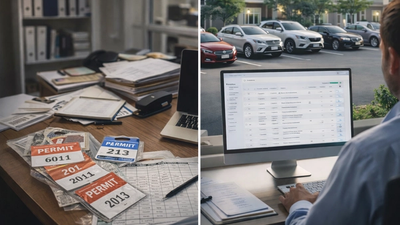
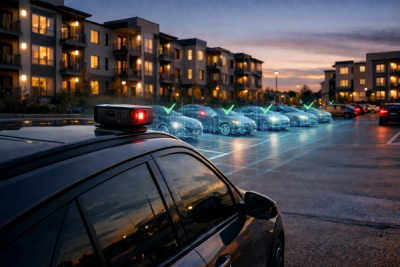
Here's why that matters for your property: LPR is the bridge between the physical world (cars sitting in your lot) and the digital world (your parking database). Think of it as creating a "Digital Twin" of your parking asset—a real-time digital representation of every vehicle on your property. This Digital Twin is the engine that makes "virtual permits" possible, replacing the guessing game of stickers and hang tags with actual, verifiable data.
The Two Types of LPR: "The Doorman" vs. "The Patrol"
Not all LPR systems work the same way. Understanding the two main types helps you decide what fits your property.
Fixed LPR (The Doorman) consists of cameras mounted permanently at entry and exit points, typically at gates. Think of it as a digital doorman—it knows exactly who's coming and going, and it can open the gate automatically for registered residents.
Fixed systems shine in gated communities and parking garages where access control is the priority. They capture 100% of vehicles entering or exiting, operate around the clock, and provide precise timestamps. The trade-off is higher upfront infrastructure cost. Fixed LPR also has one significant limitation: it tells you that a vehicle entered, but not where it parked.
Mobile LPR (The Patrol) takes a different approach. These cameras mount on enforcement vehicles that drive through your lot, scanning plates as they go. A single patrol vehicle equipped with mobile LPR can scan hundreds of plates per minute while driving at normal speeds through parking areas.
For garden-style apartments and open surface lots, mobile LPR is often the smarter choice. The capital expense is typically minimal (many enforcement vendors provide the equipment), there's no electrical or internet infrastructure to install, and the visible patrol vehicle serves as an ongoing deterrent. Mobile systems also adapt easily—if your property expands or your enforcement needs change, the technology scales with you.
With flexible platforms, you're not locked into one hardware type. Here's what many property managers don't realize: your permit software (the database where residents register) is separate from your enforcement hardware (the cameras and patrol vehicles). This means you can switch enforcement vendors—the company driving the cars through your lot—without migrating your entire permit database or forcing residents to re-register. Platforms like ApartmentPermits.com are hardware-agnostic by design, giving you the freedom to choose the vendor and enforcement strategy that works best for your specific property.
How the "Brain" Works: OCR and Context
The camera captures the image, but the real work happens in the software. Here's the simplified version of what occurs in milliseconds.
First comes Optical Character Recognition, or OCR. The camera takes a rapid burst of photos, identifies the rectangular shape of the license plate, and converts those pixels into alphanumeric characters—A, B, C, 1, 2, 3. Industry-standard systems process plates in roughly 20 milliseconds with accuracy rates typically exceeding 98%.
Modern LPR goes beyond just reading text. The software "sees" the entire vehicle and performs what's called Vehicle Fingerprinting. It cross-references the plate reading against the vehicle's visual characteristics: make, model, and color.
Why does this matter? Imagine the system reads "ABC-123" but your database shows that plate belongs to a red Ford F-150. The camera sees a blue Toyota Camry. Instead of issuing a false citation, the system flags it for human review. This layer of contextual verification prevents mistakes and protects both you and your residents.
Busting the Accuracy Myths: Mud, Darkness, and Angles
Property managers often ask the same three questions about LPR reliability. Let's address each one directly.
Myth #1: "LPR doesn't work at night."
This is actually where LPR outperforms the human eye. LPR cameras use infrared illuminators—similar to night vision technology—that project invisible light. This light reflects strongly off the retroreflective paint on license plates, producing clear images regardless of whether your lot has adequate streetlights. Many operators find their systems read plates better at 2 AM than at high noon when sun glare becomes a factor.
Myth #2: "Muddy or snow-covered plates won't scan."
Modern algorithms train on partial plate data. If the system sees "AB?123" and your database contains only one similar registration—"ABC123"—it can suggest a match with appropriate confidence scoring. The software handles the ambiguity intelligently rather than generating false negatives.
Here's the crucial point: the camera is not the enforcement. When a plate flags as "unregistered", it prompts the enforcement officer to physically inspect the vehicle. The technology filters thousands of compliant vehicles so humans can focus attention where it's actually needed. A completely mud-caked plate won't scan cleanly—but that scenario simply triggers a manual check, exactly like a physical sticker obscured by mud would.
Myth #3: "Weird parking angles cause misreads."
Mobile LPR units typically use multiple cameras—left, right, and angled positions—to capture plates regardless of how sloppily a car is parked. Modern systems read plates at extreme angles that would be difficult for a person walking through the lot to catch.
The Software Connection: The Digital Twin in Action
The camera is just a scanner. The value comes from what it talks to—and this is where your Digital Twin comes alive.
When an enforcement vehicle patrols your lot, the process works like this: the system loads your current parking data, scans plates in real time, and processes everything locally and instantly. Before any enforcement action—before a vehicle is towed or a boot gets placed—the system performs one final live verification against your database. This near-instant check catches last-minute permit registrations or guest authorizations that might have been added moments before.
This also solves the "fat finger" problem. Residents make typos. They register "O" when they meant "0" or transpose two digits. Smart plate matching uses fuzzy logic to recognize these common errors, so a resident doesn't get towed because of a simple data entry mistake. The system matches what was likely intended, not just what was literally typed.
Why "Digital Eyes" Are Better Than Physical Ones
Consider the math. A human officer patrolling on foot realistically checks around 50 vehicles per hour. That same officer in an LPR-equipped vehicle can verify over 1,000 plates in the same timeframe. One university reported that mobile LPR allowed a single officer to patrol a 1,100-space garage in 17 minutes—a task that previously couldn't be completed in an hour on foot.
Beyond speed, LPR brings objectivity. The camera doesn't have favorites, doesn't get tired, and doesn't skip rows because it's raining. It enforces the rules exactly as you've configured them in the management portal.
Then there's the data trail. When a resident disputes an enforcement action claiming they weren't parked there, you pull up the time-stamped photo with GPS coordinates. Dispute resolved. This documentation protects you legally while also building trust with residents who know enforcement is fair and evidence-based.
The Bottom Line
LPR isn't about replacing human judgment—it's about giving your team super-powered tools to manage parking effectively. The technology handles the tedious scanning and verification at scale, freeing your staff to address the situations that actually require human attention.
Reliability is no longer the question. Modern LPR systems are proven, cost-effective, and increasingly standard across multifamily properties of all sizes. The real question is this: how will you use the data to improve your residents' experience and protect your parking asset?
If your current parking strategy relies on stickers, guesswork, inferior virtual permitting systems and hoping problems sort themselves out, it might be time to see what virtual permitting can do.