The Hidden Asset in Your Parking Lot
Most multi-family properties are looking for a way to increase NOI and reduce guest parking abuse. ApartmentPermits.com can solve both of these issues by implementing a revenue strategy and digital permits.
Property managers obsess over amenities. Dog parks, rooftop lounges, package lockers—you name it, someone's running an ROI analysis on it. But most of them walk right past their biggest underperforming asset every single day: the parking lot.
Here's the tension. Residents treat parking like a birthright, not a product. Suggest charging for it and you might as well propose eliminating hot water. Yet leaving guest parking as a free-for-all costs you money, creates chaos, and ironically makes the parking experience worse for the very residents you're trying to please.
The solution isn't choosing between revenue and resident satisfaction. It's recognizing that a managed, monetized parking program delivers both. When you shift from "free and chaotic" to "managed and monetized," —using the strategies outlined in our Complete Guide for Multi-Family Communities— availability goes up, disputes go down, and yes—you actually make money.
The High Cost of "Free" Guest Parking
"Free" parking sounds generous until you realize what it actually costs you.
Start with the scarcity problem. When guest spots are unlimited and untracked, residents quickly learn they can stash their third car there, their roommate's boyfriend can camp out indefinitely, and nobody's keeping score. Meanwhile, a resident expecting her parents for the weekend can't find a single spot. According to industry data, 65% of property managers cite parking as a top concern among residents—and most of those complaints trace back to availability issues created by zero oversight.
Then there's the security gap. Free, unmonitored parking attracts problems: abandoned vehicles, non-residents using your lot as a park-and-ride, and cars that sit for weeks with no clear owner. Every one of those situations requires staff time to investigate, document, and resolve. Some require towing, which brings its own headaches and potential liability.
Finally, consider the financial leak. Yes, there's missed revenue—we'll get to that. But the hidden drain is operational. Every parking dispute your leasing team mediates, every tow truck call they coordinate, every angry resident email they answer is time not spent on leasing, renewals, or the hundred other things that actually move the needle. The "free" parking isn't free. You're just paying for it in staff hours instead of dollars.
Monetization Models That Residents Will Accept
The key to charging for guest parking without a revolt is fairness. Residents don't mind rules—they mind rules that feel arbitrary or punitive. The models that work share a common trait: they protect legitimate guests while penalizing abuse.
The Freemium Approach works because it feels like an amenity, not a fee. The structure is simple: the first 24 hours (or 48, or 72—you decide) are free. After that, guests pay a modest daily rate. This is the single best way to avoid pushback. Short-term visitors—dinner guests, weekend family—never pay a dime. But the roommate's boyfriend who's been "visiting" for three weeks? He starts getting charged on day two. One property using this model with 75 free hours per unit per month generates over $24,500 in annual profit from paid guest parking alone.
The Overnight/Prime Time Model targets scarcity when it matters most. Guest parking is free during the day but charges between 8 PM and 6 AM—exactly when resident parking demand peaks. A 469-unit community using this approach (free 7 AM–11 PM, $4/night overnight) pulls in roughly $15,000 annually. Residents appreciate that their evening parking supply is protected; guests accept a small fee for the convenience.
Premium Zone Pricing lets you charge more for the spots closest to building entrances while keeping distant spots free or cheaper. It's the same psychology as preferred parking at an airport—convenience has value, and people will pay for it.
What all these models share: they penalize long-term squatters and non-resident abusers while leaving short-term, legitimate guests untouched. That's the fairness equation that gets resident buy-in.
Technology: The Secret to Invisible Enforcement
The right technology makes paid parking work without making your staff the bad guys.
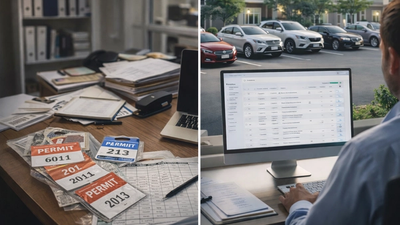
This is where we eliminate the hangtag hassle. As we discussed in our complete guide, no printing, no distributing, no "I lost my permit" excuses—the guest's license plate becomes the permit. Properties using virtual systems report dramatic drops in violations—one community saw parking infractions fall from 153 per month to just 12 within 30 days of implementation.
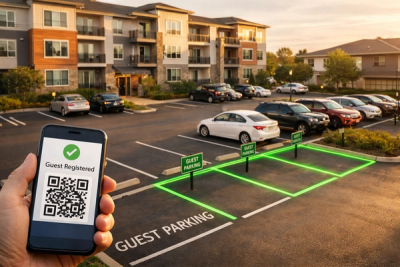
Self-service registration is non-negotiable. If guests have to visit the leasing office to get a pass, your system will fail. Modern platforms let guests register via QR code or text message, 24/7, from their phone. They enter their plate, pay if applicable, and they're done. No staff involvement required.
Automated enforcement takes your team out of the awkward position of being parking police. License plate recognition (LPR) technology checks vehicles against your database automatically. Violations trigger warnings or citations without anyone on your staff having to confront a resident or their guest. The system handles the unpleasant conversations; your leasing team handles leasing.
The integration matters too. When your permit system talks to your enforcement provider automatically, you eliminate the spreadsheets, the manual updates, and the "I swear I registered" disputes. Everything's documented, timestamped, and defensible.
The Resident-First Rollout Strategy
How you introduce paid parking matters as much as the policy itself.
Market the why, not the fee. Don't announce "new guest parking charges." Announce your "Parking Protection Program" or "Guest Parking Guarantee." Lead with the benefits: more available spots, faster guest registration, improved security. The fee is a detail; the outcome is the headline.
Grandfathering and grace periods soften the transition. Consider making the first month warnings-only—no charges, no towing, just notices explaining the new system. This gives everyone time to adapt and demonstrates you're not trying to ambush anyone.
Communicate transparently about where the money goes. Some properties explicitly tie parking revenue to community improvements—landscaping upgrades, fitness equipment, better lighting. When residents see their parking fees funding visible upgrades, the sting disappears. It's not a cash grab; it's a reinvestment in the community.
Make registration effortless. If your rollout creates more friction than the old system, you've failed. The new process should be simpler than whatever residents were doing before, even if "before" was nothing.
A Better Lot for Everyone
Paid guest parking isn't really about the money—though properties routinely add $15,000 to $30,000 in annual ancillary income. It's about control. It's about fairness. It's about creating a parking environment where residents can actually find spots, guests can easily register, and abusers face consequences.
Your parking lot is either an asset or a liability. A managed system makes it the former. Take a hard look at your current guest parking ratio, track how many spots sit occupied by the same vehicles week after week, and calculate what even a modest fee structure could generate.
The asphalt is already there. It's time to make it work for you.
Ready to see exactly how much revenue your lot is hiding?