Self-release vehicle boots for parking enforcement
Deploy once. Release remotely.
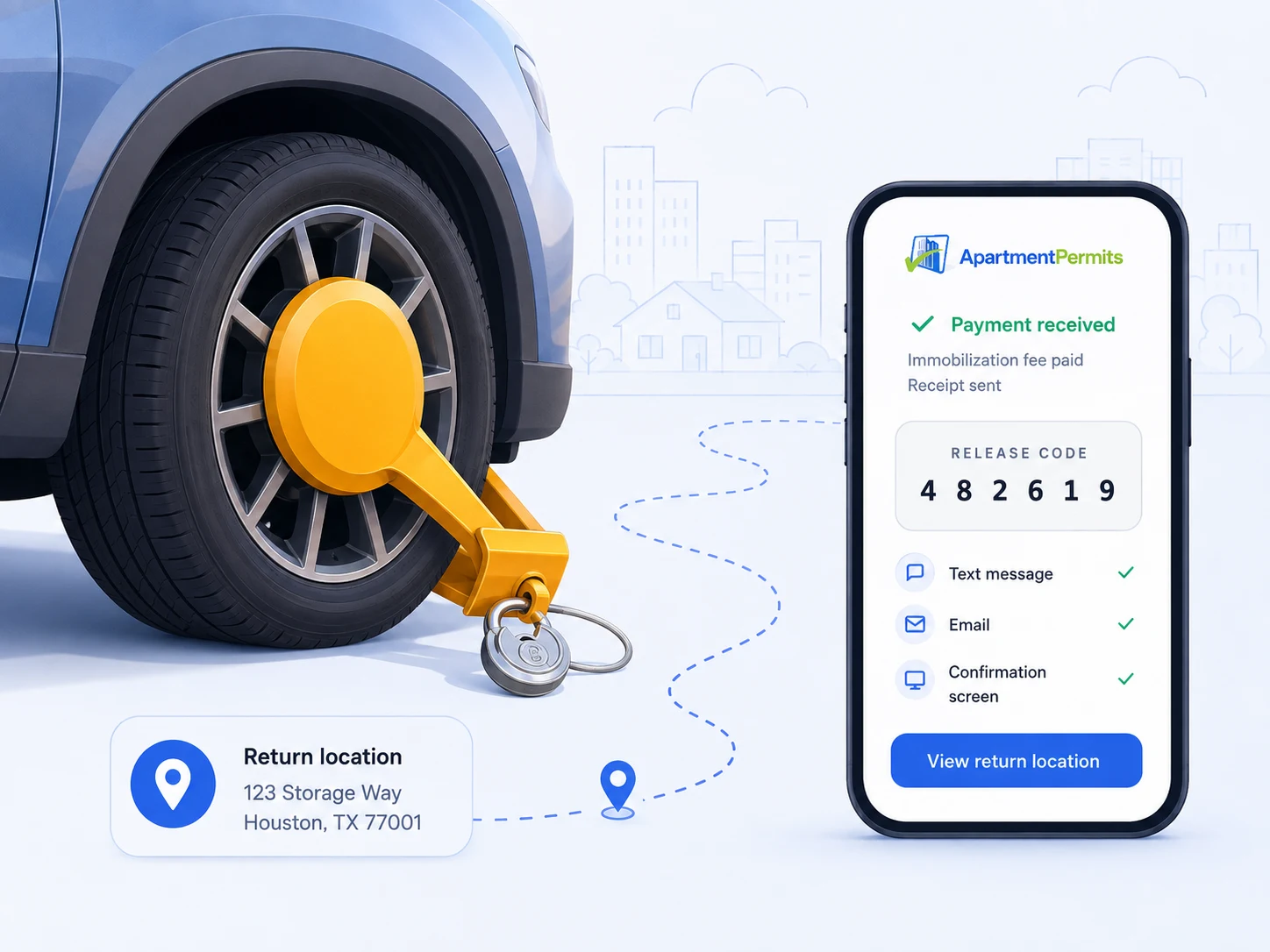
A self-releasing vehicle boot for parking and enforcement operations. Your operator immobilizes the vehicle once. The motorist pays online, receives a release code, removes the device and returns it — without a second visit from your team.
- No second dispatch
- Releases happen without sending an operator back to the vehicle.
- Codes issued on payment
- Delivered by text, email and on the confirmation screen.
- Track devices through return
- Deployments stay open until each device is checked in.
The second trip is the expensive part
Booting with operator removal requires a return visit to the vehicle. Self-release removes that removal trip, with device collection handled on a schedule.
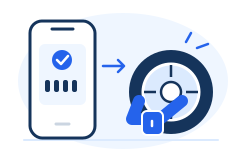
Remote self-release
A successful payment issues the unlock code automatically. The motorist releases the device at the vehicle, and your crew stays on the route it is already running.
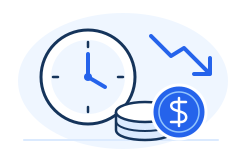
Lower cost per release
Removing the return trip removes the labor hours, the mileage and the dispatch coordination that made booting expensive to operate at scale.
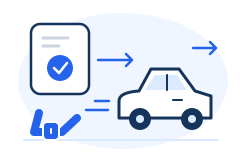
Release without the wait
Drivers can pay online and remove the boot using their release code, without waiting for a scheduled removal visit.
Traditional booting vs. self-release
Compare a typical operator-removal workflow with Apartment Permits self-release. Payment methods vary by provider; the key difference is who removes the device.
| Step | Traditional booting | Self-release |
|---|---|---|
| Deployment | Operator drives to the vehicle and installs the device. | Operator drives to the vehicle and installs the device. |
| Payment | Driver pays through the operator’s payment process, which may be online or by phone. | Driver opens the payment page, enters the boot’s serial number and pays online. |
| Coordination | Dispatcher locates an available operator and schedules a removal window. | Payment triggers code delivery; no operator removal visit needs scheduling. |
| Removal | Operator makes a second trip to the vehicle to unlock and collect the device. | Driver enters the delivered code and removes the device. |
| Device recovery | Device returns with the operator on the removal trip. | Driver returns the boot to any location designated by the enforcement company for scheduled pickup. |
Self-release removes the operator visit for unlocking the boot. Returned devices still need collection, check-in and preparation for reuse. Savings depend on your travel distances, staffing and collection schedule.
How it works
From deployment to release in six steps
Your team deploys the boot. The motorist pays, releases and returns it, with automatic code delivery and scheduled collection by your team.
- 1Operator
The boot is deployed
An enforcement operator immobilizes the vehicle and records the deployment in the field.
- 2Motorist
The motorist reaches the payment portal
A windshield notice directs the driver to the payment page, where they enter the serial number printed on the boot.
- 3Motorist
Payment is completed online
The driver pays the release and parking charges, along with a boot deposit, from their phone.
- 4System
Payment triggers release code delivery
Once payment clears, the unlock code is issued by SMS, email and on the confirmation screen.
- 5Motorist
The driver removes the boot
The code unlocks the device at the vehicle — no second visit from your crew.
- 6Motorist
The boot is returned
Drivers can return the boot to any return location designated by your enforcement company.
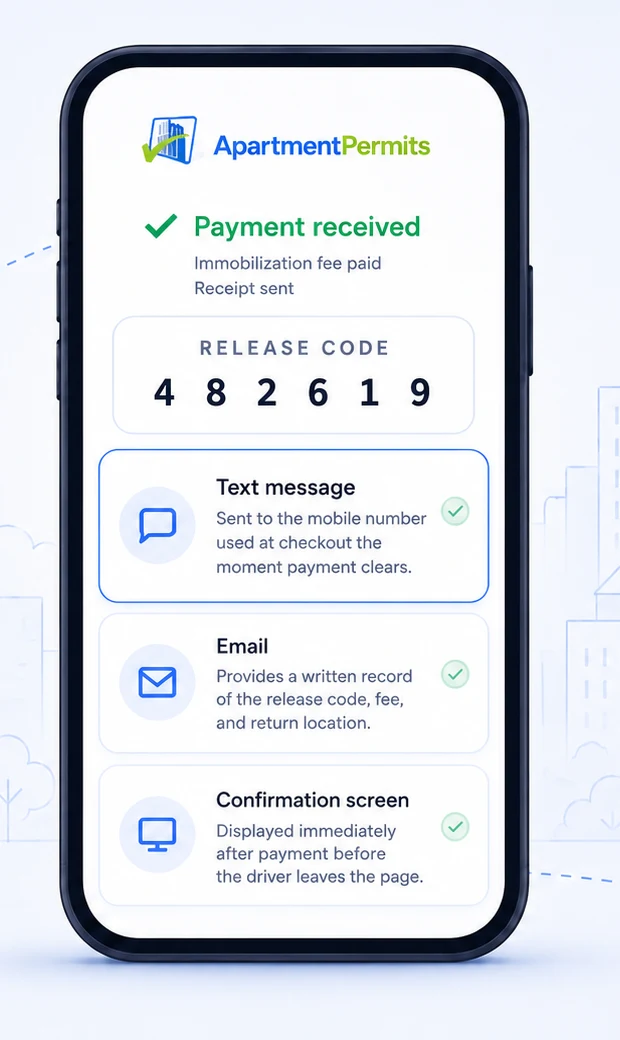
Automatic code delivery
Payment triggers release code delivery.
Code delivery is triggered by the payment itself, not by a person. The motorist sees the release code on the confirmation screen and receives the same code by text message and email, along with the return instructions for that property.
Control and recovery
You keep control of the codes and the devices

Rotatable release codes
Change or rotate a device code whenever your operation calls for it. A code issued on a previous deployment stops working once the device is rotated.

Designated return locations
Your enforcement company chooses the return locations. Drivers can return boots to any location you designate, with hours and map links included in their release instructions.

Open until it is back
Every deployment stays visible in your dashboard until the device is checked in, so outstanding hardware is tracked rather than counted at the end of the month.
Built for how enforcement actually runs
Immobilizations live in the same record as permits, violations and invoicing within our parking enforcement software, with visibility for property managers.
Remote self-release
The motorist removes the device after payment. No enforcement employee has to return to the vehicle to complete a release.
Fewer return trips
Every self-release is one fewer dispatch, one fewer round trip and one less block of employee time spent driving to a removal.
Self-service release for drivers
Drivers are not waiting in a parking lot for a truck. Once payment clears, they can release the vehicle and go.
Designated return locations
Your enforcement company chooses the return locations. Drivers can return boots anywhere you designate, with hours and map links in their release instructions.
Rotatable release codes
Codes can be changed or rotated whenever you choose, and a previously issued code stops working once the device code is changed.
Automatic code delivery
Codes are issued by SMS, email and on the payment confirmation screen the moment a payment succeeds.
Complete deployment record
Deployment, payment, code issuance, release and return are all recorded against the vehicle in one auditable history.
Device inventory tracking
See which devices are deployed, which are awaiting return and which are back in circulation across every property you cover.
Questions operators ask
Self-release boots are provided at no cost to parking enforcement operators on the Apartment Permits platform through a revenue-sharing pricing plan.
No. The boot is entirely mechanical, with no electronics, batteries or charging required. Its robust construction is designed for repeated use in parking enforcement.
Unreturned boots are tracked in your dashboard. Drivers pay a boot deposit alongside the release and parking charges. Your enforcement company is not responsible for unreturned boots.
Codes are managed by your operation and can be changed or rotated whenever you need. Rotating a device's code prevents a previously issued code from releasing that device again.
The code is delivered through more than one channel at the same time. It appears on the payment confirmation screen and is emailed alongside the SMS, so the driver can check the confirmation screen or email if the text message is delayed or sent to an incorrect number.
No. Immobilization is one enforcement option alongside towing, and the right one depends on the property, the violation and local regulations. Self-release is designed to make immobilization practical in situations where the cost of a second dispatch previously made booting hard to justify.
No. The payment portal runs in any mobile browser, consistent with the rest of Apartment Permits. Drivers open the payment page, enter the boot’s serial number, pay and receive the code without installing anything.
Immobilizations sit in the same enforcement record as permits, violations and invoicing. Property managers see enforcement activity in their dashboard, and your team works from the same vehicle history it already uses for validation and enforcement actions.
Request a demo
See a self-release deployment end to end
We will walk your team through deployment, payment, code delivery, release and device recovery using your properties and your fee structure.
Fill out a quick form and we will reach out to schedule a personalized demo.