How Workplace Parking Management Works
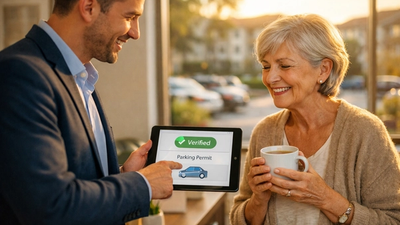
The property starts by setting permit types, vehicle limits, guest limits and parking zones. Employees then register their vehicles online. Their plate becomes the permit.
Visitors can also register from their phone. A guest may only need two hours, while a contractor could need parking for most of the day. The office sets those time limits.
- Employee Parking: Employees register their own vehicles.
- Visitor Management: Guests receive a temporary permit.
- Permit Management: Active and expired permits stay in one system.
- Parking Enforcement: The enforcement company checks the plate.
- No Mobile App: Users register through a mobile-friendly website.
This removes a lot of the small parking tasks that usually fall on the front office. There is nothing to print, hand out or replace.
What is Office Parking Management Software?
An example of how office parking management software is beneficial for office complexes in 2026 is the hybrid working model. Hybrid work changed how office parking is used. Some employees come in every day. Others only show up once or twice each week, so giving everyone a full-time reserved space may not make much sense.
How Does Parking Software Help with Hybrid Work Environments?
Parking management software can use different permits for different work schedules. A hybrid workplace may use daily permits, selected-day parking or temporary access for certain employees. This can improve space utilization without changing the size of the parking lot.
Smart parking management also gives property managers a better look at permit activity. Occupancy tracking can show how many registered vehicles are using the lot. Real-time availability may depend on the property setup and connected equipment, so permit data should not be treated like a sensor in every space.
Visitor, Tenant and Special Parking Areas
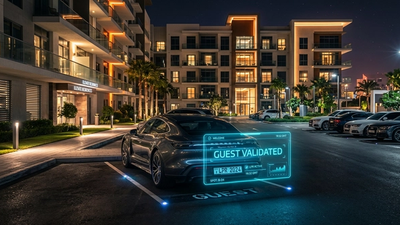
Visitor management should be simple. Guests register online, enter their plate and review the property rules. They do not need to visit the office first.
Tenant parking can work the same way. The property decides how many vehicles each tenant can register and whether extra vehicles require payment processing.
- Accessible Spaces: Keep these spaces marked and managed under property rules and local law.
- EV Charging: Create rules for vehicles using EV charging spaces.
- Carpooling: Set aside preferred areas when the property wants a carpooling policy.
- Parking Zones: Separate employees, tenants, visitors and reserved parking.
- Payment Processing: Collect payment online when paid parking is enabled.
ApartmentPermits can manage parking rules for EV charging areas, but it does not control the charging equipment. The same basic point applies to accessible spaces. The software supports the permit rules, while the property still handles signs, policies and legal requirements.
Access Control and Parking Enforcement
Parking permits are one part of access control. They show which vehicles are approved to park.
ApartmentPermits is software based. It does not require gates, RFID readers or printed tags. Some properties may still use separate access control systems at a garage entrance, but that does not mean ApartmentPermits operates the gate.
License plate recognition can help enforcement teams check parked vehicles. The plate is compared with the active permit record. Human review should still happen before towing, booting or another serious action.
SafePlate™ can also flag a close plate match. This is useful when someone enters one letter or number wrong, which happens more often than most offices probably expect.
Other Office Parking Features
Some workplace parking management tools include features outside basic permit management. These may include a parking booking system, single sign-on, Microsoft Teams connections, interactive maps or a loyalty program.
Those features are not needed for every office. A parking booking system may help when employees reserve parking on busy days. Single sign-on may be useful for a large company. Microsoft Teams or interactive maps could also fit a wider facility management setup.
But a longer feature list does not automatically make the parking system better. It can also make a basic parking process harder than it needs to be.
Comparing Office Parking Systems
Property managers may compare ApartmentPermits with Wayleadr, Parkable, TIDARO or Parkalot. Each parking system may focus on different parts of office parking, access control systems or parking reservations.
Start with the actual problem at the building:
- Are unauthorized vehicles taking employee spaces?
- Does the office still issue physical parking permits?
- Are visitors calling the front desk for help?
- Are hybrid employees holding spaces they rarely use?
- Does parking enforcement have current permit data?
- Is payment processing still handled by staff?
The answers matter more than the number of features shown on a sales page.
Paid Parking and Revenue Generation
An office can charge for visitor parking, tenant parking, extra vehicles or reserved areas. Guests and tenants can pay online when paid parking is enabled.
This can support revenue generation. Added parking income may also help net operating income, often called NOI, but the result depends on demand, rates and property costs. It should not be treated as guaranteed income.
Summary
An office parking management system replaces physical permits with online registration and license plate records. Employees, tenants and guests register online. The property sets the rules.
ApartmentPermits is a favorite software among office complexes as we focus on virtual permits, visitor management, payment processing, parking enforcement and clear permit records. It gives the office a simpler way to manage the lot without turning parking into another full-time job.